
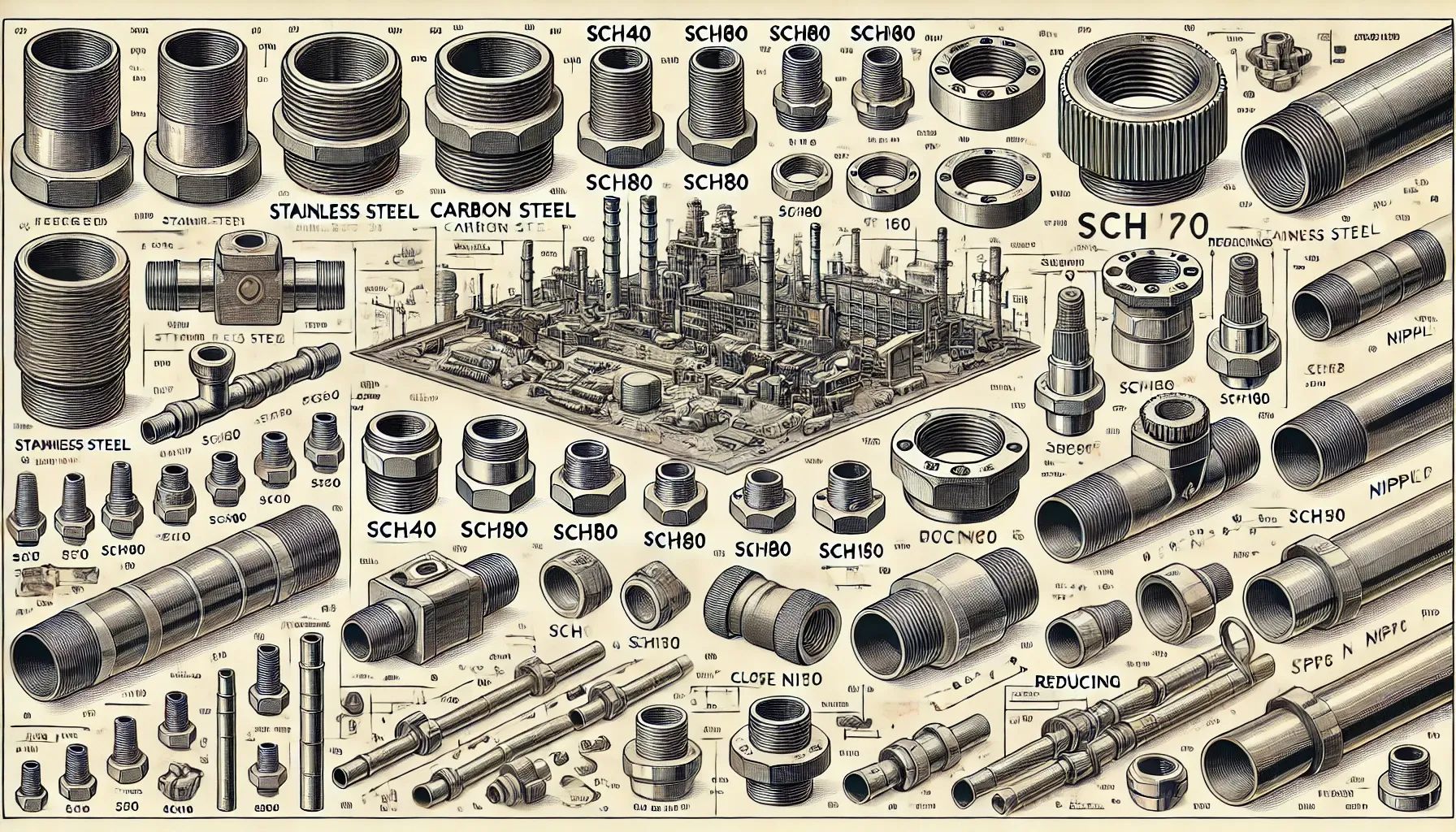
In an industrial piping system, pipe nipples are considered to be the most basic and petite components. However, when it comes to connection dependability, pressurization, and temperature handling, pipe nipples are one of the most critical parts. A pipe nipple is simply a small section of pipe with threads on one or both ends which serves to connect valves, instruments, and fittings or to extend the length of a pipeline in restricted spaces. However, failure to account for temperature and pressure ratings when selecting pipe nipples is an oversight we commonly notice in industrial plants. This error tends to be inconspicuous during installation but mushrooms into a monumental problem when there’s leakage, rupture, or thread damage while operating.
Why Pipe Nipple Selection is Not as Simple as it Looks
It is not enough to just match the thread size and length of pipe nipples; selection relies on more complicated factors like the fluid nature, system operating pressure, working temperature, material compatibility, and type of connection. Each pipe nipple fitted onto an industrial line is subjected to combined stresses from internal pressure, thermal expansion, constant vibration, fluid velocity, and infrequently, chemical attack. If the material or thickness of the nipple does not withstand these conditions, there is almost an absolute absolute failure at a threaded joint due to its section being the weakest within any connection.
Choosing incorrectly results in thread leakages, cracks resulting on the surface of the nipple, bending under insufficient loading, rapid corrosion and in some cases even nipple breakage under sudden pressure spikes. Knowing how to properly select a pipe nipple is not solely a design challenge, it revolves around plant safety and effective maintenance strategies.
Material Selection According to Pressure and Temperature
The bonnet lock nipple is made out of different types of materials. Steel or galvanized iron are used for low pressure water lines and general air piping, since the temperature is ambient and the fluid is non-aggressive. Yet, mild nipples are known to show limits when the pressure and temperature go beyond standard conditions. For steam lines, high pressure air circuits, chemical transfer lines, or high pressure oil circuits, carbon steel or stainless steel nipples are standard due to the metal's superior tensile strength and corrosion resistance.
In the case of high temperature, SS304, SS316, and other grades of stainless steel nipples are preferred for industries due to risk of corrosion or hygiene requirements. For aggressive chemicals and marine environments, SS316 is fantastic. In some instrumentation and refrigerant lines, brass or copper are utilized, however, they only work in low pressure systems.
Nipples made from PVC or CPVC are suitable for cold water or low-pressure drainage, whereas they are completely ineffective for high temperature or high-pressure conditions.
Schedule and Thickness Matter More Than People Think
Industrial nipples are made in distinct schedules such as SCH40, SCH80, or SCH160, each advanced level possessing thicker walls and greater pressure tolerance. Picking SCH40 nipples on a pipeline meant to utilize SCH80 piping is a disaster waiting to be exploited since pressure handling capacity is automatically less.
PED dictates that SCH80 is the bare minimum standard for steam or high-pressure water lines and even superheated steam hydraulic circuits operate with SCH160 or seamless heavy wall nipples for safety reasons.
Alongside the shoulder engaged thread depth, threaded nipples require precise machining due to the increased threat vulnerability under load. The application of PTFE tapes, anaerobic sealants, and some thread sealing compounds are only as reliable as the metal base strength post seals permit.
Length and Connection Type is Not Just About Fitment
Nipple length selection is deemed a fitment problem, however longer nipples in high-pressure systems uniquely possess bending stress weaknesses or vibration impact. Short close nipples possess rigid constituents hence free from vibration use.
The presence of a hexagon in the center of a hex nipple allows for more effective tightening, as well as improved torque control. When there are no proper flow dynamics, long reducing nipples may be used, however, they are not ideal because a decrease in diameter will affect flow velocity as well as pressure drop.
Under very high pressure or temperature conditions, welded end nipples outperform other types, and the opposite is true for threaded end nipples. This is due to the threads acting like stress concentrates under load. For critical operations, seamless nipples with no welds and precise machining are always the safer choice.
Conclusion
Pipe nipple selection has to do with an engineer's choice depending on the operating pressure, temperature, type of fluid, the material, joint design, and compatibility of the material with other parts. Considering pipe nipples as ordinary hardware can lead to unwanted leaks, failures in connections and corrosion, and serious maintenance issues later. Every industrial system has its requirements, and maintenance engineers, piping designers, and purchasing teams need to make sure that every system is technically fit, especially in sensitive lines.
We offer an extensive catalog of carbon steel, stainless steel, brass, copper, and high-pressure seamless industrial pipe nipples. At Indusroof, we focus on meeting the set standards and providing multiple grades and schedules, including precise threading standards, in order to guarantee robust and dependable connections in any industrial setting.

Validate your login