
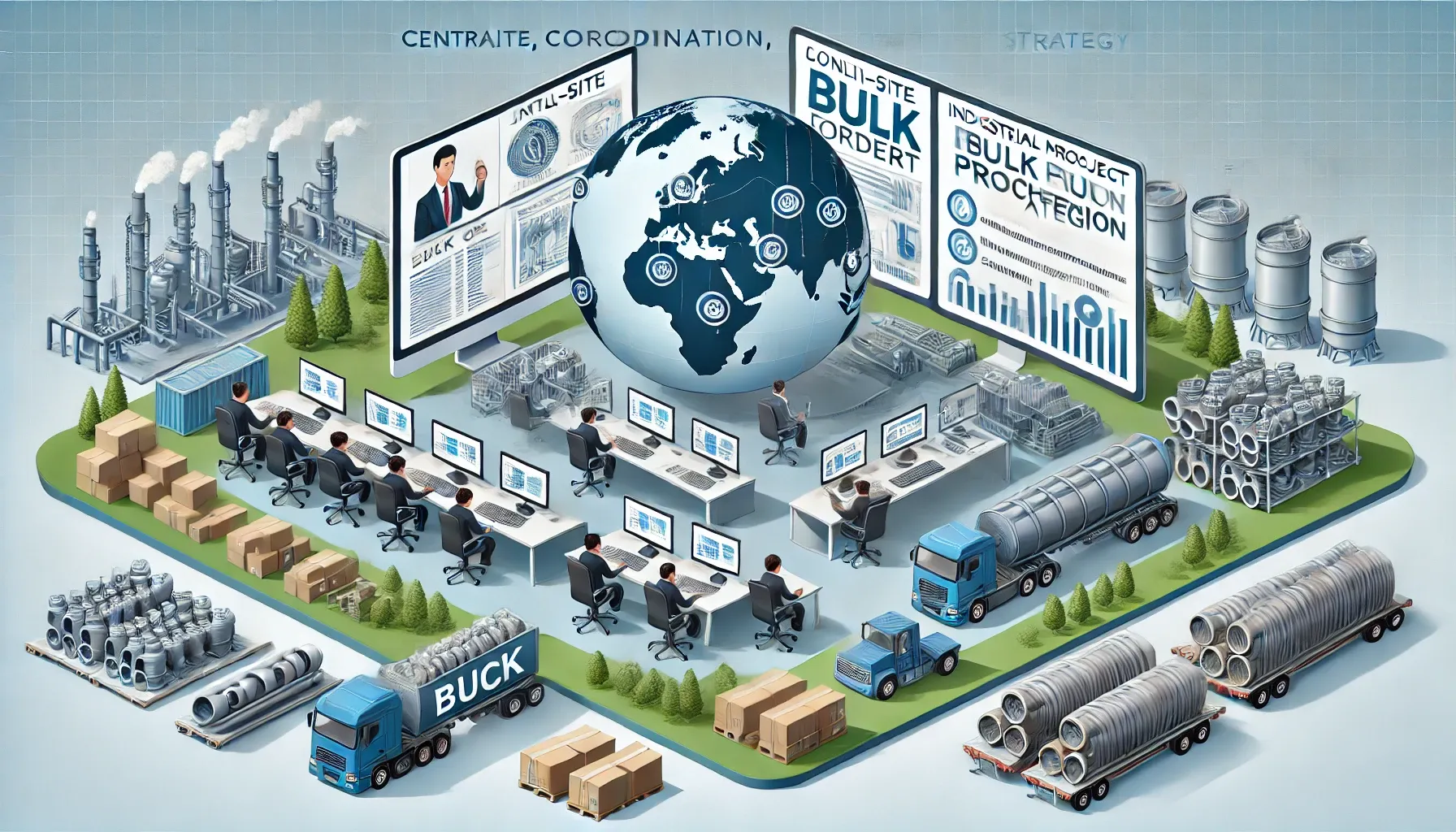
Managing procurement for one site is already an intricate dance of coordination, quality control, and delivery pressure. Now, picture that for multiple geographic locations, and you can see the complexity spiral out of control. Multi-site industrial projects bring about frightening site-specific realities — unique site requirements, differing consumption rates and shifting priorities, local logistical constraints, spatial limitations, and uncompromising deadlines set by clients. In this environment, one of the most effective approaches to controlling cost while improving efficiency and avoiding last minute panic is having a detailed bulk procurement plan. But here’s the elephant in the room, bulk procurement is not simply about purchasing large quantities to achieve discount prices. It is a detailed, reasoning strategy that requires precise integration of timing, standardization, forecasting, and supplier management.
Why Bulk Procurement in Multi-Site Projects is Not Optional But Necessary
The purchasing problem resulting from buying units of large materials over specific types of works is one of the most challenging problems facing contractors in multi-site industrial projects. Each site has its own requirement list, its own requests for proposals (RFQ s), its own negotiations, and its own delivery. This model not only destroys negotiating power, but also multiplies operational irritation such as inconsistent quality, price differentiation, duplicate efforts, and inventory mismatches.
The issues mentioned above are handled by bulk purchasing at the foundational level. It Centralised Purchasing Power. Bulk purchasing develops a common standard for all sites material specifications, consolidates site demand forecasts subdivision's and empowers the project owner to negotiate with the control supplier(s). The impacts are visible instantaneously: Improved pricing, consistency in quality, lesser freight costs per unit, simplified documentation, and expedited material availability.
The First Rule of Bulk Procurement — Site Consumption Planning is Everything
No bulk strategy can be successful without planning consumption on a site basis which is known as consumption based planning. This entails every site having to submit its demand within the scope of work as accurate consumption forecasts linked with their execution schedules.
Quantity estimates should take into consideration buffer stock for rework, material wastage, unexpected site conditions as well as the current scope of work. These require smart procurement teams to break them down into phase-wise requirements: what is needed right away, what is needed in the next 30 days, and what can wait.
This visibility enables procurement to consolidate orders and bundle requirements across multiple sites instead of being reactive towards each site’s urgent supplies failing to meet these needs in advance.
Why Standardisation of Material Specs is Non-Negotiable
Differences in site material specification ‘check’ non-standardised materials specifications is the biggest killer in taking advantage of bulk procurement. For instance, a single site ordering ASTM A105 flanges and another asking for EN 1092 flanges for the same application has any hope of negotiating with a single supplier.
A successful bulk procurement process starts with a technical alignment meeting with project managers, design crews, and site engineers who are tasked with locking custom specifications for pipes, fittings, valves, gaskets, fasteners, cables, supports and all other high-frequency consumables.
This enhances order volume while simplifying storage, inspection, and replacement across all sites.
How to Create Smart Delivery Schedules Across Sites
When dealing with bulk procurement multi-site strategies, it is unwise to dump all material at one central warehouse and figure out distribution at a later stage. A much smarter strategy is delivery zoning, which is grouping sites geographically and scheduling constrained deliveries by phases according to how prepared each site is.
For some materials such as long lead items, or imported valves, early delivery may be required. Supply of consumables and certain hardware items can follow JIT (just in time) supply directly from the suppliers. These techniques eliminate some of the risks associated with blocked inventory, damaged materials, unnecessary storage, and even increased costs.
Effective bulk procurement plans always consider available space on site, local transport, available access routes, restrictions during monsoons, and area specific access difficulties for planning delivery.
Why Supplier Relationship Becomes More Powerful in Bulk Procurement
Many companies think bulk buying simply means squeezing the supplier's wallet in order to get the lowest rate possible, but it’s so much more than that. With bulk procurement it becomes important to develop strategic partnerships with suppliers, in which they fully grasp the need for multi-site demand for your project and understand its importance.
Suppliers selected for bulk procurement must have available capacity, a reliable storage facility, wider delivery network, and technical support teams that are stationed at different site locations so they can easily move around and troubleshoot swiftly.
Site disputes and confusion are sometimes triggered by differing documentation provided at different locations. To avoid this, all supplier agreements should standardize payment terms, warranty test certification, and dispatch documentation.Conclusion
Conclusion
The bulk procurement plan is the extreme survival strategy for multi-site industrial projects—not merely a money-saving activity. It does bring order, uniformity, and effectiveness to the most disordered part of project execution—material supply. For it to work, however, site teams must dedicate time to appropriately plan their requirements, design teams must commit to spec’s standardization, and the procurement teams must commit to real collaboration with the suppliers instead of thinking about them as vendors.
Standardized material supply with consolidated ordering and project-wise documentation offered by us at Indusroof facilitates industries with multi-site bulk procurement strategies. In real industrial projects, when done right, bulk procurement is not just a monetary expense, but a saving in time, energy, and headaches which no one wants in the future.


Validate your login