
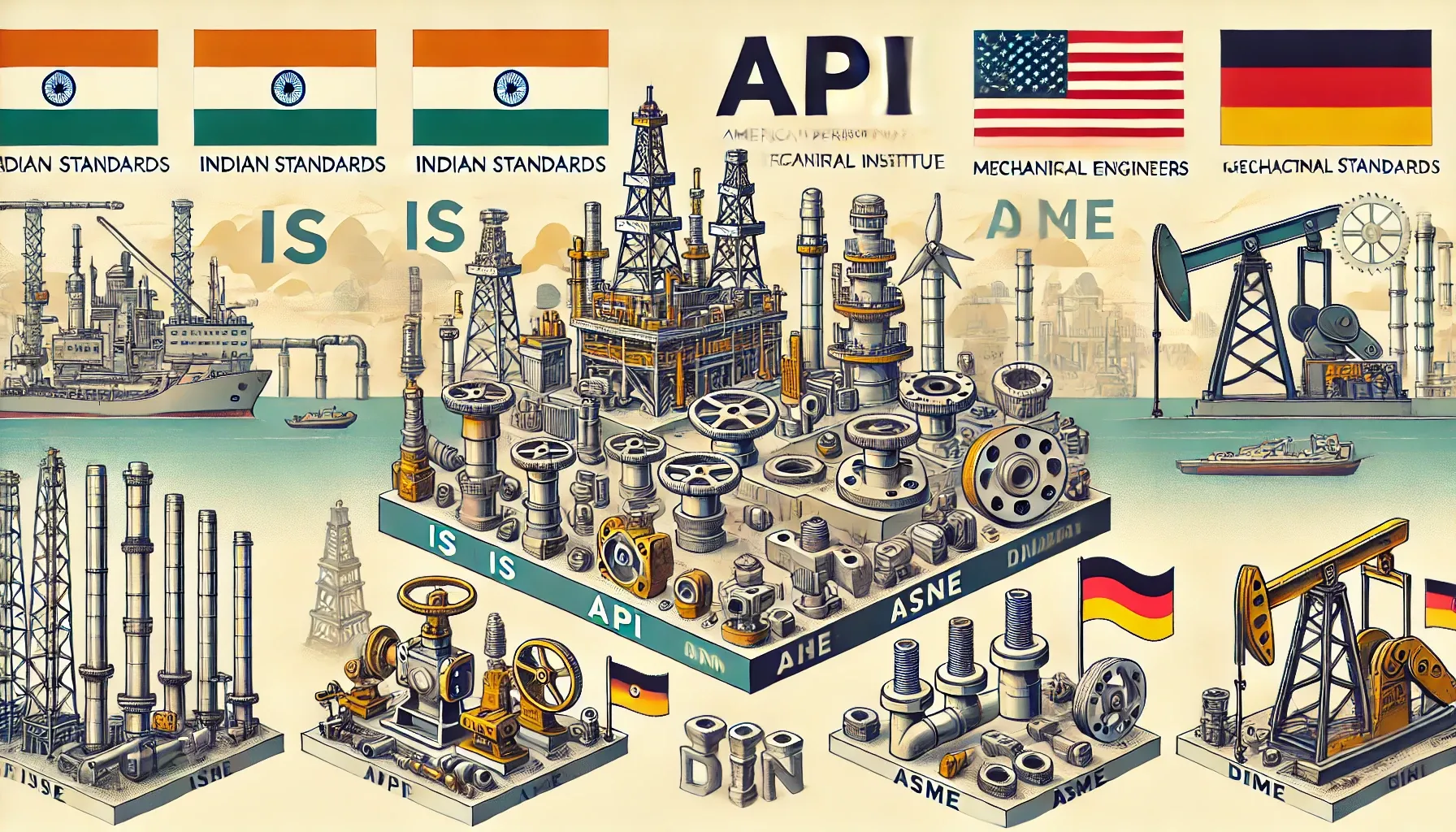
When it comes to industrial hardware and engineering components, standards are absolutely critical. They form the basis for compatibility, quality, safety, and performance across the globe. Whether one talks about valves, pipes, flanges, fasteners, fittings, or any other critical mechanical part, standardization is indispensable for both manufacturers and buyers to ensure that there is no industrial application error, mismatch, or failure. However, during procurement or project meetings, one often hears IS, API, ASME, and DIN standards being mentioned as if they mean the same thing with complete disregard to the fact that these standards are quite different from each other. In fact, these four standards are from entirely different organizations, regions, and technological perspectives.
This post will elaborate on how IS, API, ASME, and DIN standards differ from one another focusing on the context of industrial hardware used in manufacturing, construction, oil & gas, power plants, chemical industries, and infrastructure projects.
IS Standards – Bureau of Indian Standards (BIS)
IS is the acronym used for Indian Standard. The Bureau of Indian Standards (BIS)—the sole body for national standardization in the country—issues and governs these standards. IS Standards are formulated exclusively for Indian industries considering their local raw materials, environmental conditions, climate, and operational settings prevalent in Indian industries.
In the case of industrial hardware, IS standards range from pipes, fittings, valves, fasteners, flanges, to Structural Steel, Welding and Testing Practices. The IS standards most frequently referred to in procuring hardware are IS 1239 concerning pipes, IS 2062 concerning structural steel, IS 1367 concerning fasteners, and IS 6392 concerning flanges. The IS standards aim at making components economically and technologically accessible to the Indian marketplace while imposing reasonable constraints on safety and durability.
IS standards, however, do not have the same extent of acceptance as international standards, for instance, ASME or DIN, at a global level. This implies that for IS designed export projects, or multinationals working together, the IS standards are not sufficiently meeting the requirements of the global client unless explicitly stated.
API Standards – American Petroleum Institute
The American Petroleum Institute is well recognized worldwide for creating technical standards called API. These standards are bespoke and serve exceptionally well to the oil and gas industry. API standards ensure safety and the ability to work under high pressure and severe conditions, particularly in oilfields, offshore platforms, refineries and petrochemical plants.
API gives special consideration to industrial hardware such as valves, pipes, flanges, pumps, pressure vessels, drilling tools and other such tools. API has specific value assignments, for instance, API 6D is the international benchmark for pipeline valves, API 5L covers line pipes, 600 deals with gate valves for petroleum industries.
API hardware is designed to withstand extreme conditions such as high-pressure, high- temperature, corrosive environments, and volatile materials. API grade and industrial hardware embrace extra testing, inspection, material paid document and certification. API certified API products' toughness comes at a cost as they are stringent. precision safety and quality spend more but that is the price of cost effective reliability.
ASME Standards – American Society of Mechanical Engineers
ASME standards serve as the foundation for worldwide mechanical design and manufacturing practices including but not limited to piping systems, pressure vessels, and power plant equipment. ASME is not a governmental body but a technical society of great repute which specifies sophisticated design codes and standards for the industrial fabrication, testing, inspection and certification of equipment.
For hardware implementations, ASME B16 series is widespread for Flanges, fittings and valves. ASME B16.5 stipulates pipe flanges, ASME B16.34 stipulates valves and ASME B16.9 stipulates butt weld fittings. ASME standards focus on extreme calculations of pressure, temperature, wall thickness, material grade, dimensional tolerances and the more.
In plant and industrial piping design, ASME standards are imperative for critical applications that involve service steam, chemicals, high-pressure gas or liquid. Standard-compliant equipment and components are more reliable, accepted internationally, and ensure passing stringent industrial audits.
DIN Standards – Deutsches Institut für Normung (German Institute for Standardization)
Originating from Germany, the whole of Europe and some parts of Asia extensively use DIN standards. These standards are renowned in Germany for their precise measurements, consistency in manufacturing, and accuracy of product dimensions. DIN standards are more concerned with specific measurements, tolerances, and fitment accuracy unlike IS or ASME standards that focus strongly on pressure ratings.
Acclaimed throughout the world, industrial hardware that uses DIN standards include fasteners, nuts, bolts, washers, bearings, hydraulic fittings, and machined parts. Borehole engineering and general engineering, along with the automotive and machine-building industries, prefer DIN fasteners for their accurate thread patterns and tighter tolerances.
European industries use DIN standards for modules of machinery and equipment precision engineering, such as associating hex bolts with DIN 933, nuts with DIN 934, and washers with DIN 125. European industries incorporate DIN hardware into works that require high precision and interchangeability of parts.
Conclusion
The IS and API standards deal with Indian market considerations and oil and gas industry safety issues respectively while ASME and DIN standards focus on global oil and gas mechanical system safety precision requirements and advanced engineering alongside automotive domains. All four standards are fundamental to the hardware’s engineering but differ in scope, application, and commercially relevant region.
To make a more practical selection, an engineer, procurement officer, or plant design specialist must take into account the project’s geographical location, the surrounding working conditions, recommendation from an overseas client, and how critical the application is. By knowing these distinctions, these professionals can sidestep technical blunders, compliance oversight, and expensive discrepancies.
Indusroof focuses on manufacturing compliance with both domestic and international standards. This has led us to the acquisition of full documentation and certification support accompanying the supply of industrial hardware components tailored to IS, API, ASME, and DIN standards for every single industry.

Validate your login