
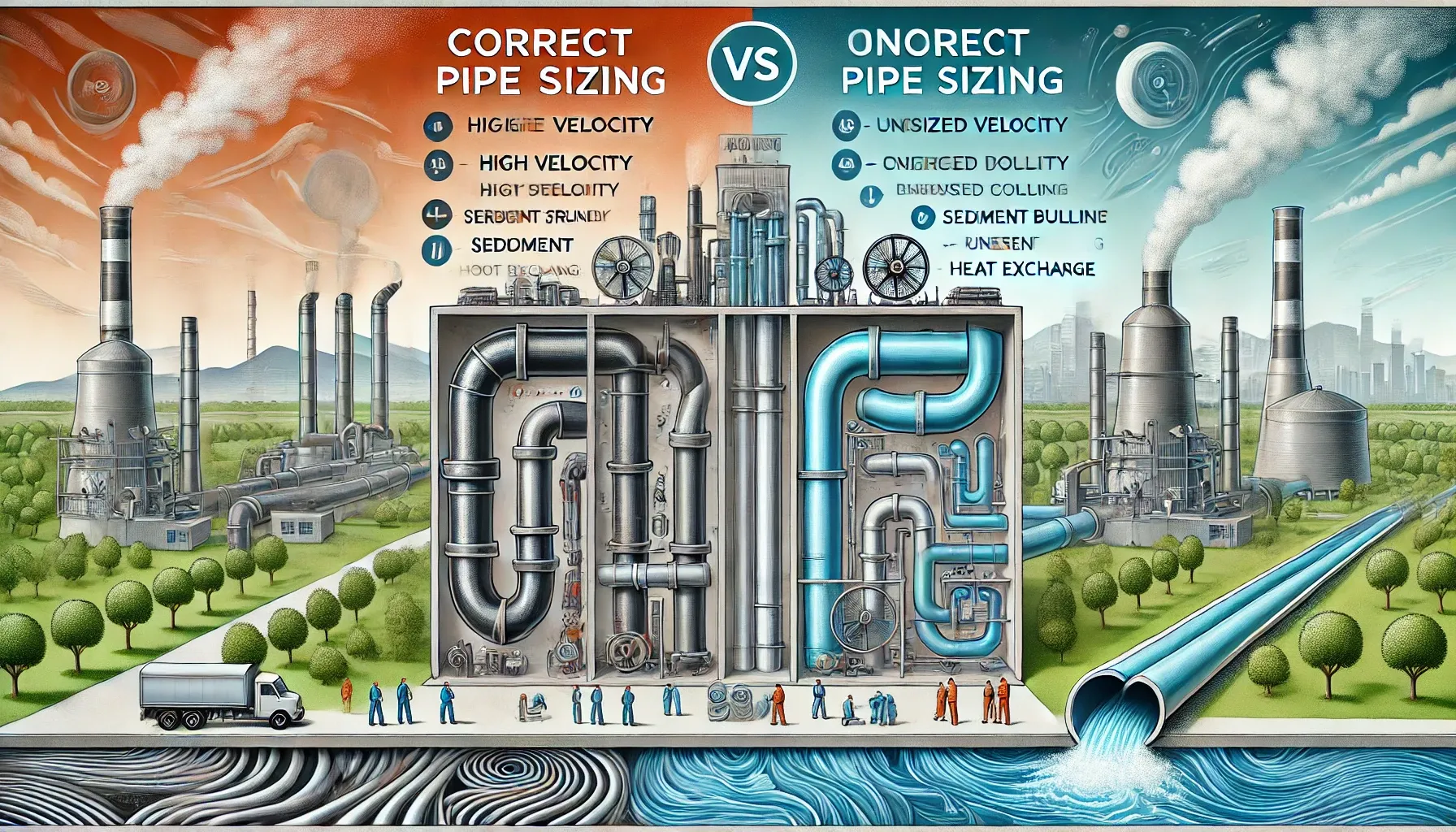
In modern HVAC equipped commercial buildings, industrial plants, data centers, malls, hospitals, and hotels, the systems are not only responsible for heating or cooling, but also maintaining comfort, process control, and stability throughout. Behind the workings of every chiller, cooling tower, and air handling unit (AHU), there is an unnoticed workhorse that is equally important — the piping network. And this is exactly where most HVAC projects go south — wrong pipe sizing. During discussions about energy rating, compressor brands, and tonnage, the sad truth remains – improper piping in HVAC systems increases energy bills and maintenance, places additional stress on equipment installing imbalanced flow, system choking, and, worst of all, decreases efficiency globally.
The Role of Piping in HVAC Systems Goes Beyond Just Flow
HVAC piping serves much purpose beyond the mere transportation of chilled/hot water or refrigerant from one area to another. It determines the effectiveness of thermal energy transfer within a building. It serves as a crucial structural highway. Proper pipe alignment and sizing ensures that every area in the network has uniform flow rates, optimization of velocities, minimal pressure drop, and effective heat exchange.
Incorrect pipe sizing compromises this entire equilibrium. Regardless of how sophisticated the chiller is, or how contemporary the pump is – the moment the pipe size is incorrect there is an absolute loss in efficiency on the HVAC system every single day.
What Happens When Pipe Size is Too Small in HVAC Systems
The prevalence of undersized piping in HVAC systems is a surefire way of operational agony. It is quite a known fact that small diameter pipes increase the friction loss which would lead to increased pressure drop, for the entire system. This results in pumps increasing their workload leading to higher consumption of energy and in certain cases, exceeding the pump capacity which leads to insufficient flow.
With reference to chilled water systems, undersized pipes lead to poor circulation, uneven cooling, temperature imbalance across zones, and increased stress on the chillers because of low return water flow.
In case of split AC units or the VRV/VRF system, under-dimensioned refrigerant lines lead to a higher refrigerant velocity and noise alongside potential oil return issues which puts a strain on the compressor.
When dealing with fan coil units or AHUs located at the far end of the network, under dimensioned piping causes low flow and hence low transfer of heat. This translates into increased running times and inappropriate regulation of temperature in crucial rooms.
What Happens When Pipe Size is Too Large — It’s Not Always Better
It is a common myth that larger is better. In the case of HVAC systems, using pipes that are too big presents its own unique challenges.
When large pipes are used, the velocity is lowered to subpar levels, which results in poor heat exchange in coils, flow stagnation, and pose the risk of creating sediment or air pockets.
In systems that chill water, using oversized pipes results in extremely low velocity which causes laminar flow. This in turn, reduces branching flow, increases bacterial growth, and fouling.
Using oversized refrigerant pipes stops oil from being sent back to the compressor and disrupts lubrication to the compressors, which leads to long term damage.
Using large pipes also means larger material costs and spending money on additional insulation. Most importantly, this does not result in any real benefits.
Direct Impact of Wrong Pipe Sizing on Pumps and Energy Bills
Choosing pumps for HVAC systems always correlates to which pipes are used. Single pipes increase the amount of resistance in the system which forces the pump to run on a higher head. This leads to increased energy usage and shortens the lifespan of the pump.
Using large pipes reduces resistance but pushes the pump away from the optimal BPM. This results in a weak operation, vibration, and waste of energy.
In both scenarios, inadequate pipe dimensions disconnect pumps from their peak performance due to improper pumping head curve yielding increased energy costs and wasted system productivity.
The Chain Reaction Impact on System Maintenance & Reliability
When HVAC systems malfunction as a result of incorrect pipe dimensions, maintenance failures proliferate throughout the network. Valves and other parts on the boundary of high-pressure zones begin to leak prematurely. Air pockets form in stagnant low-flow regions which lead to corrosion as well as a gurgling sound.
An uneven temperature split throughout all of the branches forces the maintenance to take the manual approach to throttle the valve resulting in a broken hydraulic equilibrium which fosters uneven cooling or heating.
Inelastic cases of pipe dimensions imbalance will lead to increased trips on the chiller, overloading the compressor, pump overheating, unintentional standby time, and other costly maintenance issues — all fuelling complaints from clients.
Smart Pipe Sizing is Not Just Diameter — It’s System Design Logic
Sensible sizing of the HVAC piping systems also considers exact engineering specifications which are: required flow rate (LPM or GPM), set limits on velocity (m/s), targeted friction losses (kPa or m/100m), as well as total dynamic head computations. Each fluid type, such as chilled water, condenser water, and refrigerant, have set ranges of velocity which need to be maintained to ensure proper heat exchange and avoid noise and erosion.
Sprinkled with examples:
- Velocity of chilled water ranges from: 1.0 to 2.5 m/s
- Velocity of condenser water ranges from: 1.0 to 2.0 m/s
- Range for refrigerant gas line: 8 to 15 m/s
- Range for refrigerant liquid line: 0.5 to 1.0 m/s
Exceeding these boundaries increases operational risks.
Conclusion
As for HVAC systems, having incorrectly sized pipes is very similar to having human arteries that are either too wide or too narrow for the heart — the system stands a chance of surviving, but never reaching its peak performance. Smart pipe sizing is not about trying to cut corners with material costs, or about providing excess space for safety, but precision, efficiency, and lifecycle savings.
Indusroof not only sells industrial-grade HVAC pipes, fittings, and valves, but also pre-purchase and post-purchase technical support which guarantee precise piping networks that deliver performance at minimal energy costs and future maintenance.
Validate your login